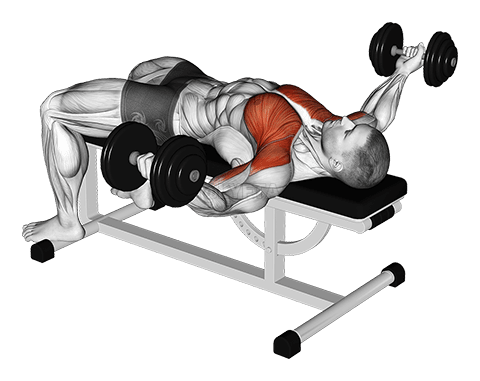
Dumbbell Flat Flye Hold Isometric
Exercise Profile
Related Exercises:






Get the exercise library in your pocket!
Introduction to the Dumbbell Flat Flye Hold Isometric
The Dumbbell Flat Flye Hold Isometric is a targeted strength training exercise that primarily works the chest muscles, with secondary benefits to the shoulders and arms. This exercise is suitable for individuals at all fitness levels, particularly those looking to enhance upper body strength and muscular endurance. By incorporating this into a workout routine, one can improve muscle tone, promote better posture, and increase overall body stability.
Performing the: A Step-by-Step Tutorial Dumbbell Flat Flye Hold Isometric
- Extend your arms straight above your chest, but don't lock your elbows. This is your starting position.
- Slowly lower the dumbbells in a wide arc on either side until they are level with your chest. Your arms should remain slightly bent at the elbows.
- Instead of returning the dumbbells to the starting position, hold them at the lowest point of the arc, engaging your chest muscles. This is the isometric hold.
- Hold this position for the desired amount of time or repetitions, ensuring your chest muscles remain contracted and engaged throughout.
Tips for Performing Dumbbell Flat Flye Hold Isometric
- Controlled Movement: Lower the dumbbells out to your sides in a wide arc while keeping your arms slightly bent at the elbows. Stop when your arms are parallel to the floor and hold this position. The common mistake here is to drop the arms too low, which can strain the shoulders.
- Maintain Tension: The key to effective isometric exercises is maintaining tension in the muscles throughout the movement. In the case of the Dumbbell Flat Flye Hold Isometric, ensure that your chest muscles remain engaged even when your arms are fully extended.
- Breathe Properly: Don't hold your breath during the exercise. Instead, breathe in as you lower
Dumbbell Flat Flye Hold Isometric FAQs
Can beginners do the Dumbbell Flat Flye Hold Isometric?
Yes, beginners can perform the Dumbbell Flat Flye Hold Isometric exercise. However, it's important to start with a light weight to ensure proper form and prevent injury. This exercise primarily targets the chest muscles but also engages the shoulders and arms. As with any exercise, it's a good idea for beginners to have their form checked by a fitness professional to make sure they're doing it correctly.
What are common variations of the Dumbbell Flat Flye Hold Isometric?
- Dumbbell Decline Flye Hold Isometric: This version is done on a decline bench, placing more emphasis on the lower chest muscles.
- Single-Arm Dumbbell Flye Hold Isometric: In this variation, you perform the exercise with one arm at a time, which can help to improve muscle imbalances.
- Dumbbell Flat Flye Hold Isometric with Resistance Bands: Adding resistance bands to the exercise can increase the intensity and provide a constant tension on the muscles.
- Dumbbell Flat Flye Hold Isometric with Stability Ball: Performing this exercise on a stability ball adds an element of balance, which can engage your core and improve your overall stability.
What are good complementing exercises for the Dumbbell Flat Flye Hold Isometric?
- Push-ups: Push-ups are a bodyweight exercise that also works the chest, shoulders, and triceps. They provide a functional full-body movement that complements the targeted muscle isolation of the Dumbbell Flat Flye Hold Isometric.
- Cable Crossovers: This exercise uses a different type of resistance (cable machine) but targets the same muscle groups as the Dumbbell Flat Flye Hold Isometric. It helps to improve muscle balance and coordination, which can enhance the effects of the isometric hold.
Related keywords for Dumbbell Flat Flye Hold Isometric
- Dumbbell chest exercise
- Isometric chest workout
- Dumbbell flat flye routine
- Strength training for chest
- Dumbbell workout for pectoral muscles
- Isometric exercises with dumbbells
- Flat flye hold workout
- Dumbbell chest flye hold
- Isometric chest strengthening
- Dumbbell flat flye for chest muscle.