Pike Push-up
Exercise Profile
Related Exercises:




Get the exercise library in your pocket!
Introduction to the Pike Push-up
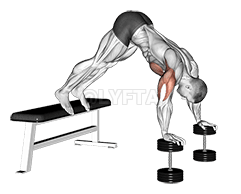
The Pike Push-up is a challenging upper body exercise that primarily targets the shoulders, chest, and core, while also engaging the arms and back. It is suitable for intermediate and advanced fitness enthusiasts who are looking to enhance their strength, stability, and muscular endurance. Individuals would want to incorporate this exercise into their routine for its efficiency in improving upper body power and its ability to be performed without the need for any gym equipment.
Performing the: A Step-by-Step Tutorial Pike Push-up
- Lift your hips up and back into a downward dog position, keeping your back flat and your head between your arms so your body forms an inverted V shape.
- Lower your upper body towards the ground by bending your elbows, keeping your legs straight and your heels lifted off the floor.
- Push your body back up to the starting position, maintaining the inverted V shape throughout the movement.
- Repeat this process for the desired number of repetitions, ensuring to keep your core engaged and your movements controlled.
Tips for Performing Pike Push-up
- **Head Positioning**: When you lower your body, aim to bring the top of your head down towards the ground, not your nose. This is a common mistake that can lead to neck strain. Your gaze should be directed towards your feet throughout the movement to maintain a neutral neck position.
- **Elbow Alignment**: Another common mistake is flaring out the elbows during the descent. To avoid this, keep your elbows tucked in towards your body as you lower down. This will not only protect your shoulders but also engage the correct muscles in your upper body.
- **Engage Your Core**: Keep your abs and glutes engaged throughout the exercise. This will help
Pike Push-up FAQs
Can beginners do the Pike Push-up?
Yes, beginners can do the Pike Push-up exercise, but it might be challenging as it requires a good amount of upper body strength and flexibility. It's important to start slow and maintain proper form to avoid injury. If it is too difficult, beginners can modify the exercise or start with basic push-ups to build strength before attempting the Pike Push-up. It's always recommended to consult with a fitness professional to ensure exercises are being performed correctly.
What are common variations of the Pike Push-up?
- The Wall Pike Push-Up involves placing your feet against a wall and walking your hands towards the wall, creating a vertical push-up that targets the shoulders and upper body.
- The One-Leg Pike Push-Up involves lifting one leg off the ground during the push-up, adding an additional challenge to your balance and core strength.
- The Wide-Hand Pike Push-Up is a variation where your hands are placed wider than shoulder-width apart, placing more emphasis on the chest and shoulder muscles.
- The Narrow-Hand Pike Push-Up involves placing your hands closer together than in a traditional pike push-up, increasing the difficulty and focusing more on the triceps.
What are good complementing exercises for the Pike Push-up?
- Dips: Dips are a great complementary exercise to Pike Push-ups as they also target the upper body, specifically the triceps and shoulders, but they also engage the chest and back muscles, offering a more comprehensive upper body workout.
- Planks: While not a push-up variation, planks complement Pike Push-ups by strengthening the core, which is crucial for maintaining proper form and balance during Pike Push-ups, thus enhancing the overall effectiveness of the workout.
Related keywords for Pike Push-up
- Pike Push-up Workout
- Body Weight Chest Exercise
- Home Chest Workout
- Pike Push-up for Chest
- Bodyweight Pike Push-up
- No Equipment Chest Exercise
- Pike Push-up Training
- Pike Push-up Bodyweight Exercise
- Pike Push-up Chest Workout
- Bodyweight Chest Strengthening Exercise
Do Pike Push-up in the Lyfta app
Save this exercise, log your sets, and follow full workouts — free on iOS and Android.